
DALLAS COUNTY PROPOSITION A. THE IMPLEMENTATION PLAN
HERE'S HOW
PROP A WORKS
Dallas County Prop A would connect more people with serious mental-health and substance-use issues to treatment, reducing repeat crisis calls so police, fire and EMS can focus more of their time on public safety and emergencies.
It scales a coordinated response that has already cut daily street homelessness in Downtown Dallas by more than 80% to every part of the county. This page lays out exactly how: where the teams go, what the money buys, who is accountable and when it comes online.
THE PLAN BY THE NUMBERS
11,000
HOUSEHOLDS NEED HELP EACH
YEAR
to leave homelessness in Dallas
County.
40%+
CAN'T GET IT TODAY
because the system doesn’t have the capacity
4,500+
MORE HOUSEHOLDS SERVED
every year once Prop A is fully running.
$99.6M
PER YEAR, FULLY ACCOUNTED FOR
with county oversight, audits and public reporting.

THE PROBLEM
IS CAPACITY
The challenge
Close to 11,000 households in Dallas County need help each year to get out of homelessness. The community has expanded its investment, but more than 40% of those households still can't get the support they need. People get stuck in shelter, beds stay full and others are left sleeping outside, where they are nine times more likely to end up in the criminal justice system. That is how encampments grow, and it puts real strain on hospitals, crisis response systems and the Dallas County jail.
The Solution
Prop A creates a Dallas County Homeless Solutions fund to scale proven strategies into every part of the county. It builds on the same coordinated operating model that has already cut visible street homelessness in Downtown Dallas, with county oversight, coordinated funding and measurable results.
The Goal
No adult, family or young person forced to sleep outside. The plan is designed to close the funding gap and ensure that all 11,000 households experiencing homelessness each year have access to a pathway out of homelessness.

A PROVEN MODEL, SCALED COUNTYWIDE
Since 2021, Dallas County's homeless response system has made measurable progress through aligned investment, shared accountability and stronger partnerships. In 2024, that coordinated capacity was focused on Downtown Dallas. Outreach workers, behavioral health providers and law enforcement worked under one strategy to engage people sleeping outside, connect them to shelter, treatment and housing, and keep encampments closed once people were brought indoors.
80%+
reduction in daily street counts conducted by Downtown Dallas Inc.

Every Single
major downtown encampment resolved.
20%+
reduction in violent crime downtown.
FIVE ZONES. ONE COORDINATED RESPONSE.
The system runs through five existing geographic zones, each with a dedicated Coordinated Street Response team. Teams work with behavioral health specialists, first responders, management districts and neighborhoods to engage people and connect them to shelter, treatment and housing pathways.
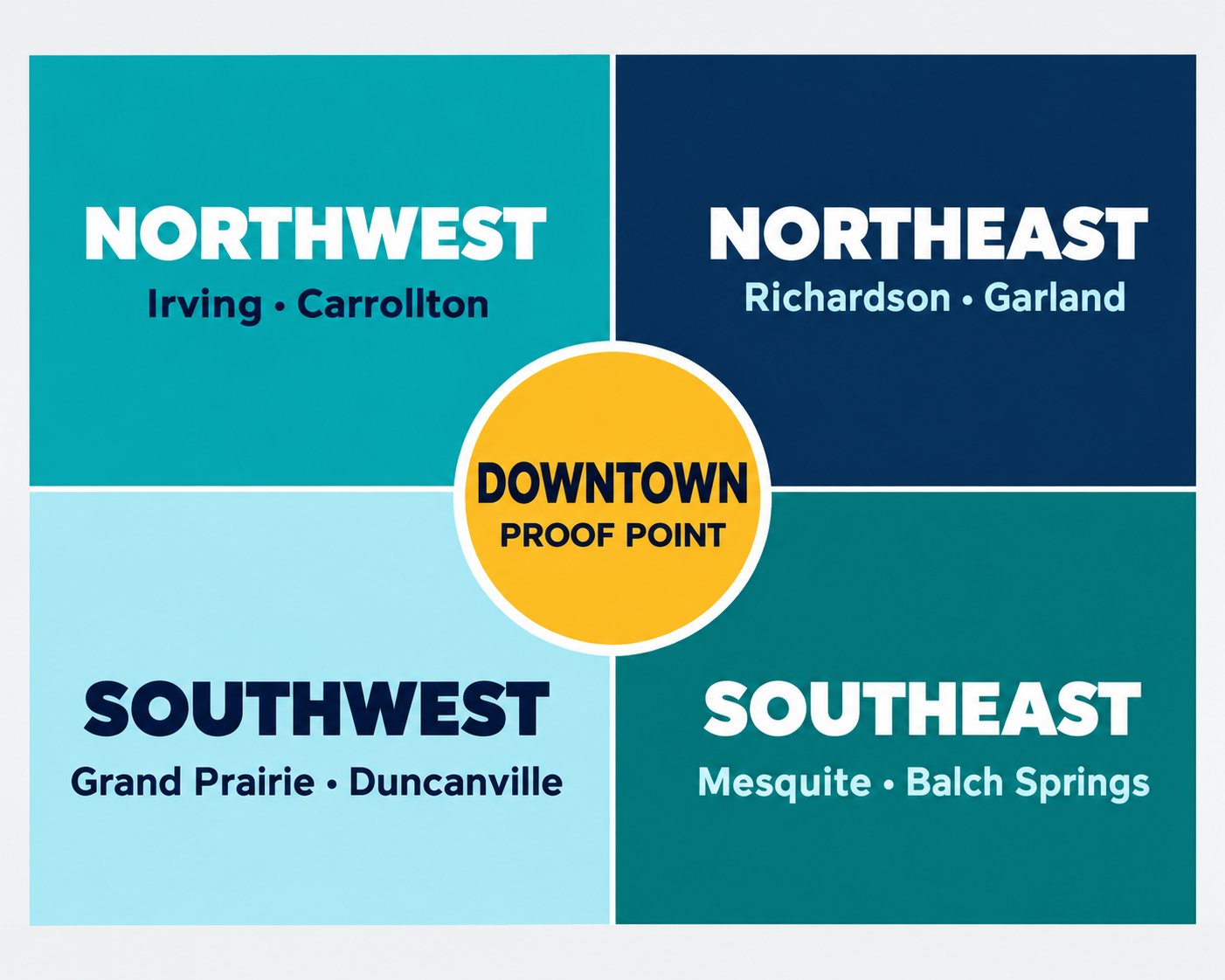
Every zone gets
■
A dedicated Street Response Team with expanded outreach capacity.
Proactive, daily outreach guided by consistent service standards and measurable performance outcomes.
■
Embedded behavioral health specialists to address mental health and addiction needs.
■
Real-time shelter, treatment and housing coordination to help people move off the streets quickly.
■
Clear public safety response protocols to address safety concerns and connect people to appropriate levels of care.
■
FOUR STRATEGIES
STRATEGY 1
Coordinated Intake Hubs
Coordinated Intake Hubs at local service providers give law enforcement, first responders and outreach teams a central place to bring people for immediate connections to behavioral health treatment, crisis care, shelter and housing stabilization.
● Immediate triage and medical screening
● Diversion specialists who help households avoid long shelter stays
● Beds set aside for police and first responder drop-off
● Behavioral health support and crisis stabilization beds
● Connection to shelter, recovery and housing
STRATEGY 2
Resolve and prevent street homelessness
Equip street response teams to engage people sleeping outside and connect them directly to services, shelter, treatment and housing.
● Coordinated street response in every zone, including on-demand response to reports of people sleeping outside
● Targeted hotspot resolution that maps and prioritizes the largest concentrations first
● Shelters equipped to resolve homelessness with a stabilization plan from day one
● Specialized response for complex needs through weekly coordination with first responders, hospitals and behavioral health
STRATEGY 3
Keep public spaces safe and open
Once people have a way indoors, coordinated public space management keeps large encampments from coming back. Street teams, local governments, business owners, management districts and law enforcement work together.
More outreach ambassadors and private security
Proactive outreach to people in the area
Patrols after encampments are resolved
Re-activating public spaces with fencing and security where needed
STRATEGY 4
Reduce jail use
People forced to sleep outside are nine times more likely to spend time in jail. Preventing street homelessness, along with these targeted strategies, is estimated to help avoid thousands of jail book-ins each year.
● No discharge to the street: coordinated release with the county Justice Department
● Faster access to in-patient psychiatric care for people with severe mental illness
● Housing and treatment for frequent jail users through the FUSE program
● New deflection beds that divert low-level offenses away from jail

EVERY PERSON, THE RIGHT PATHWAY
Outreach and intake lead to triage. From there, each household is matched to the help its situation actually calls for, from a one-time fix to supportive housing. Housing navigation, unit acquisition and flexible funding move people into homes.
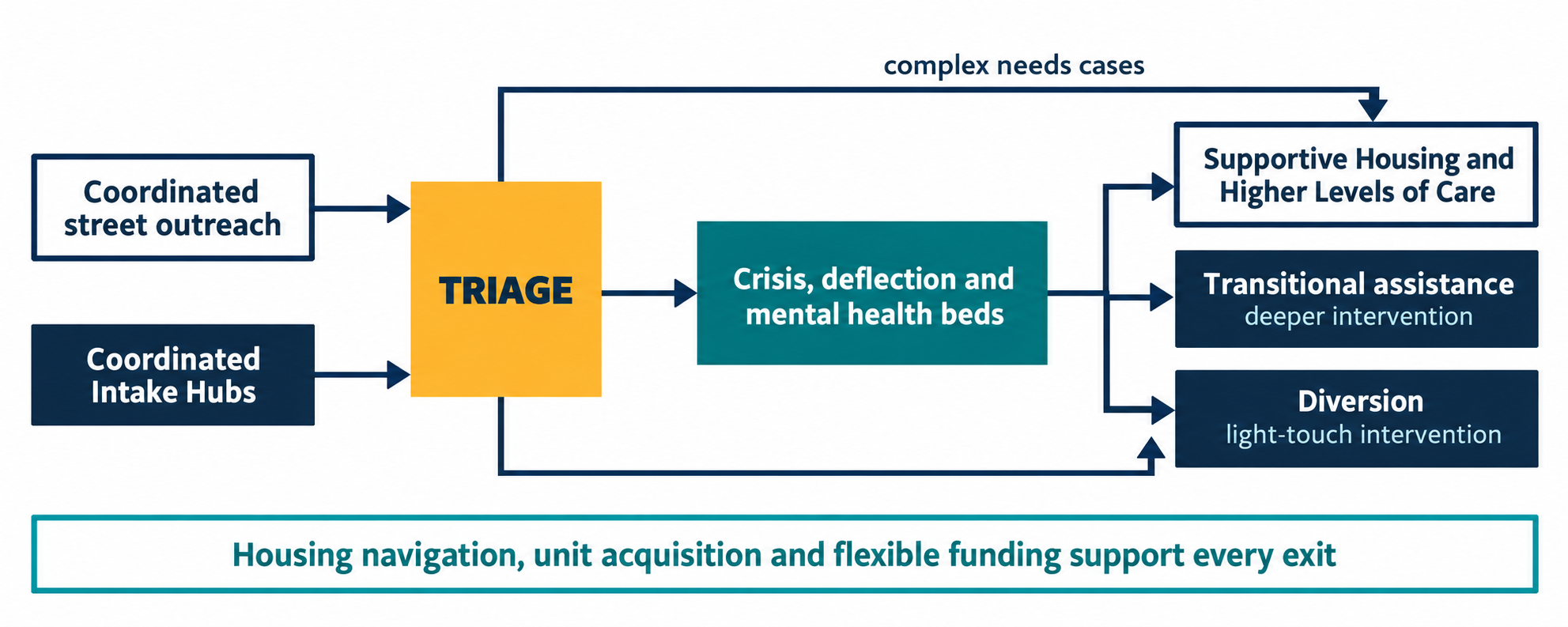

THE FRONT DOOR:
COORDINATED INTAKE HUBS
The hubs give hospitals, emergency responders and law enforcement a place to bring someone besides an emergency room or a jail cell. People are assessed on the spot and connected to the help that fits. The hubs use existing service provider facilities, so the money goes to services, not new buildings.
24/7

intake, behavioral health triage and on-site medical care
24
crisis stabilization beds for acute behavioral health crises
Everywhere
Each zone served by hubs at local service providers
WE'RE
ALREADY
PAYING FOR IT
Dallas County taxpayers already pay for homelessness through hospitals, emergency rooms, crisis response and jail operations. Those systems manage the consequences without solving the problem. Each year there are about 8,400 jail book-ins among people who are unsheltered, including more than 1,200 criminal trespassing charges, many tied directly to living outside.
National research is consistent: when communities expand access to housing and services, arrests, jail use, emergency visits and overall taxpayer costs go down. In Denver's landmark supportive housing study, participants saw:
30%
fewer jail stays
27%
fewer jail days
34%
fewer police contacts
40%
fewer arrests
The Urban Institute found supportive housing cut arrests for homelessness-related offenses by more than half. Prop A is built to resolve homelessness faster and lean less on the most expensive public systems.
THE CHALLENGE IS REACHING
MORE HOUSEHOLDS
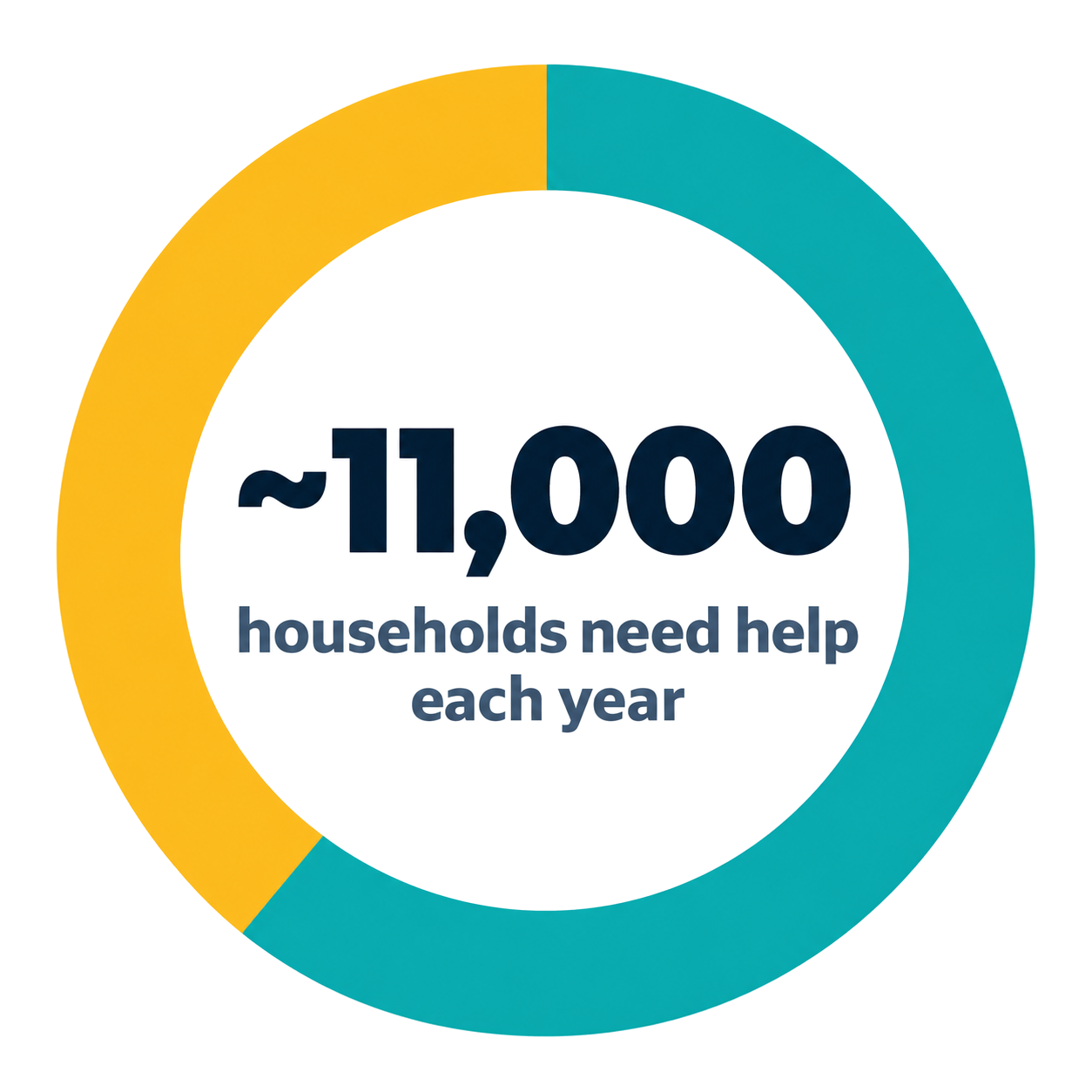
~60% currently reached
~40% go without help
The plan: pathways out of homelessness for everyone
The system runs a predictive analysis of how many households need each kind of help annually, compared with what it can deliver today. Prop A closes the gap.
LIGHT TOUCH
Diversion
Small, one-time help that quickly keeps or gets people housed

5,040 served today · +2,160 with Prop A
MODERATE
Transitional assistance
A short-term bridge to stability

850 served today · +2,350 with Prop A
INTENSIVE
Supportive housing
For people with the most severe needs

335 served today · +275 with Prop A
Coordinated Intake Hubs
Streamlined drop-off, triage and immediate connection to shelter, treatment and housing
■
Served by today's system
■
Added by Prop A (households per year)
TAXPAYERS ARE NOT
WRITING A BLANK CHECK
The county stays in control
Dallas County retains oversight. Funding is tied to a five-year agreement with clear performance expectations, and the county evaluates results and decides how dollars are deployed going forward.
WHAT GETS MEASURED AND REPORTED
Performance-based contracts
The fund runs through the county's existing performance-based contract with the federally designated lead agency for homelessness. Money reaches providers through established procurement procedures under one unified strategy.
Audited and public
Every dollar is subject to performance measures, annual financial audits, compliance monitoring and regular public reporting, so taxpayers can see how funds are spent and what they deliver.
Exits from homelessness
Reduction in street homelessness
Length of time homeless
Returns to homelessness
Encampments resolved
YEAR 1: VISIBLE PROGRESS
ACROSS THE COUNTY
The first year ramps up in four steps, so residents see results in their own neighborhoods as capacity comes online.
STEP 1
RESOLVE EXISTING
ENCAMPMENTS
Plan and carry out a housing surge to resolve the first encampments, then close additional ones.

STEP 2
ENGAGE NEW
PEOPLE QUICKLY
Coordinate and carry out closure workflows with partners in each zone.
STEP 3
TRIAGE, DIVERT OR
TRANSPORT TO SHELTER
Activate the hubs and scale diversion assistance. Open centralized intake to match people to beds and services in real time.
STEP 4
ACCELERATE HOUSING AND TREATMENT
Centralize intake and matching, scale housing pathways and build in access to treatment.
WHAT WE EXPECT
The plan is built on five principles and judged on four outcomes: resolving homelessness for every household each year so shelters don't overflow, immediately resolving encampments, helping people leave homelessness and stay self-sufficient, and reducing street homelessness.
No adult, family, veteran or young person
should be forced to sleep outside.
Public spaces must stay safe and accessible for everyone.
Resources should be coordinated and driven by performance.
People should be matched to the right help at the right time.
Results require managing public space and resolving each household's homelessness.
VOTE FOR PROP A
Early voting runs Oct. 19–30. Election Day is Tuesday, Nov. 3, 7 a.m. to 7 p.m., at any Dallas County vote center.
Sources
1. Dallas County Homeless Solutions Implementation Framework, May 2026.
2. Dallas County Homeless Solutions: Scaling What Works, October 2026.
3. Dallas County Health and Human Services (2024). The cost of homelessness in Dallas and Collin counties.
4. Cunningham, M., Gillespie, S., Anderson, J. and Pergamit, M. (2021). Breaking the homelessness-jail cycle with supportive housing: Results from the Denver supportive
housing social impact bond initiative. Urban Institute.
5. Urban Institute (2021). Ending homelessness through supportive housing, not policing.
6. Corporation for Supportive Housing (2023). FUSE 10-year follow-up report.
7. Downtown street counts conducted by Downtown Dallas Inc.